NIST CSF 2.0 for Cloud: The 2025 Implementation Guide
Your CISO just walked into your office with that look, the one that says another framework is about to land on your already overflowing plate.
“We need to implement NIST CSF 2.0 in our cloud environments by 2025,” they announce. You nod politely while mentally calculating how many nights and weekends this will cost you.
But what if implementing NIST CSF 2.0 for cloud wasn’t the nightmare you’re imagining?
The reality is, most security teams struggle with applying frameworks like NIST to their cloud infrastructure because they’re trying to force traditional approaches onto modern environments. You need a practical roadmap that actually works for cloud, not another theoretical exercise.
Ready to transform your cloud security posture without the typical implementation headaches? Here’s what nobody’s telling you about making NIST CSF 2.0 work in real cloud environments.
Understanding NIST CSF 2.0 Updates for Cloud Environments
A. Key differences between NIST CSF 1.1 and 2.0
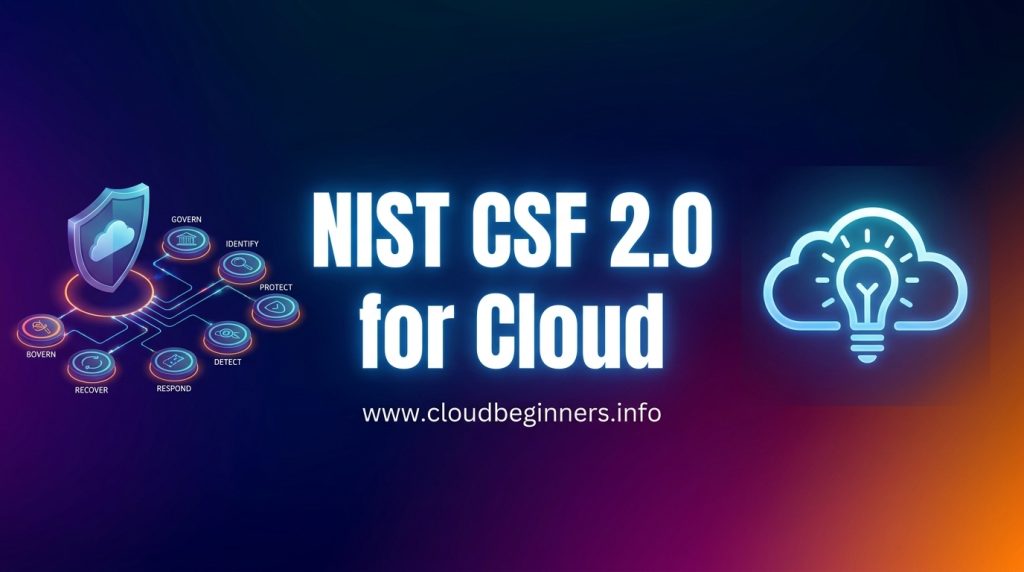
You’ll notice significant changes in NIST CSF 2.0 compared to its predecessor. The 2.0 version has completely reimagined the framework’s structure to better address modern security challenges.
| CSF 1.1 | CSF 2.0 |
|---|---|
| Five functions: Identify, Protect, Detect, Respond, Recover | Six functions: Govern, Identify, Protect, Detect, Respond, Recover |
| Focus on IT security | Expanded scope covering broader organizational risks |
| Limited cloud guidance | Robust cloud security considerations |
| Limited supply chain focus | Enhanced supply chain risk management |
The addition of the “Govern” function is particularly important for your cloud operations, as it emphasizes leadership’s role in security decision-making and accountability.
B. Cloud-specific enhancements in the 2.0 framework
NIST CSF 2.0 now directly addresses cloud security challenges you face daily. The framework now includes:
- Specific guidance for securing multi-cloud environments
- Updated controls that align with cloud-native architectures
- Clear direction on applying shared responsibility models with your cloud providers
- Integration points between on-premises and cloud security controls
You’ll find these enhancements especially helpful when implementing security across AWS, Azure, GCP, or any combination of cloud providers.
C. Timeline for mandatory implementation by 2025
Mark your calendars! While NIST CSF remains voluntary for private organizations, many regulatory bodies are adopting it as a compliance requirement with a 2025 deadline:
- Q2 2023: NIST CSF 2.0 final release
- Q3-Q4 2023: Industry-specific implementation guides published
- 2024: Transition period for organizations to adapt
- January 2025: Expected mandatory implementation for government contractors
- Q2 2025: Full compliance expected for regulated industries
D. Benefits of early adoption for cloud security posture
Getting ahead of the 2025 deadline offers you significant advantages:
- You’ll identify and remediate security gaps before they become compliance issues
- Your cloud security maturity will improve organically rather than through rushed implementations
- You’ll gain competitive advantage in markets where security is a differentiator
- Your risk of costly breaches decreases significantly
- You can avoid the implementation bottlenecks that will occur as the deadline approaches
Core Components of NIST CSF 2.0 for Cloud Infrastructure
A. Governance and supply chain risk management
When implementing NIST CSF 2.0 in your cloud infrastructure, you’ll need to overhaul your governance approach. The framework now puts much more emphasis on third-party risk – something you can’t ignore in cloud environments where you’re essentially outsourcing parts of your security to providers.
Start by mapping your cloud supply chain completely. Who has access to your data? Which vendors support your critical systems? The 2023 updates to NIST CSF specifically address these blind spots that many organizations miss.
Your governance model should clearly define:
- Who owns security decisions for each cloud asset
- How security requirements flow down to providers
- When and how providers must report security incidents
- What compliance evidence you need from each vendor
Remember that in cloud environments, the shared responsibility model means you’re still on the hook for many security controls even when using managed services. Your governance documents should reflect this reality.
B. Identity and access management adaptations
Cloud environments demand a different IAM approach than on-premises systems. With NIST CSF 2.0, you need to implement identity safeguards that work across your multi-cloud landscape.
The most effective strategy? Zero Trust principles aligned with NIST’s guidelines. This means:
- Implementing just-in-time access instead of standing privileges
- Requiring MFA for all cloud administrative access
- Using service accounts with strict scope limitations
- Setting up conditional access based on device health, location, and behavior analytics
Cloud-native IAM tools from your providers won’t give you the complete picture. You’ll need to either implement a Cloud Infrastructure Entitlement Management (CIEM) solution or build federated identity management that spans your entire cloud footprint.
The 2025 best practice is to implement continuous verification rather than periodic access reviews. Your permissions should automatically adjust based on risk scoring.
C. Data protection strategies across multi-cloud environments
Your data protection approach needs special attention when implementing NIST CSF 2.0 across multiple cloud providers. Each provider handles encryption, data loss prevention, and data lifecycle management differently.
Start by classifying your data consistently across all environments. Then implement:
- Standard encryption requirements regardless of cloud provider
- Cloud-native DLP tools configured to similar sensitivity thresholds
- Data sovereignty controls that respect regulatory requirements
- Cross-cloud backup and recovery processes
The framework now specifically calls out data security as its own function rather than burying it within other categories. This reflects the reality that data-level controls are often your last line of defense in cloud environments.
Don’t rely on default provider settings. AWS, Azure, and GCP all have different approaches to encryption key management. You’ll need to standardize these practices or implement a cloud security posture management (CSPM) solution to enforce consistent data protection.
D. Continuous monitoring requirements in cloud ecosystems
NIST CSF 2.0 significantly expands monitoring requirements for cloud environments. You’re now expected to have near real-time visibility across your entire cloud infrastructure.
The challenge? Most organizations use multiple monitoring tools that don’t talk to each other. To meet the framework’s expectations, you’ll need:
- Centralized logging from all cloud providers
- Automated anomaly detection that works across environments
- Asset inventory systems that continuously discover cloud resources
- Cloud configuration monitoring that alerts on drift from secure baselines
Cloud infrastructure moves fast – resources spin up and down automatically, configurations change, and new services deploy continuously. Your monitoring needs to match this pace.
Consider implementing a Security Information and Event Management (SIEM) solution that can ingest cloud logs or a Cloud-Native Application Protection Platform (CNAPP) that provides integrated visibility across your cloud footprint.
E. Incident response in distributed cloud architectures
Cloud changes everything about how you respond to security incidents. With NIST CSF 2.0, your incident response playbooks need to specifically address cloud scenarios.
The most critical updates to make:
- Develop provider-specific escalation procedures (AWS, Azure, GCP all have different support models)
- Create containment strategies that work in auto-scaling environments
- Implement cloud-native forensics capabilities that preserve evidence
- Establish communication channels with each provider’s security team
Cloud incidents often involve shared responsibility confusion. Who handles what when an incident spans your code and the provider’s infrastructure? Your response plans need to clearly delineate these boundaries.
Test your cloud incident response regularly through tabletop exercises and simulations. Many organizations discover major gaps only during actual incidents because they never practiced cloud-specific scenarios.
Practical Implementation Steps for Cloud Service Models
Tailoring CSF 2.0 for SaaS Environments
When implementing NIST CSF 2.0 in your SaaS setup, you’ll need specific approaches that address the unique challenges of this model. Start by identifying which security controls you can configure versus those managed by your provider. Most SaaS platforms offer security dashboards where you can:
- Enable multi-factor authentication across all user accounts
- Configure data loss prevention settings
- Implement least privilege access controls for all users
You’ll find that CSF 2.0’s Govern function works perfectly for establishing clear responsibilities between you and your SaaS vendor. Create a responsibility matrix that maps each CSF function to either your team or your provider.
Remember, your biggest risks in SaaS environments are typically unauthorized access and data leakage. Focus your implementation efforts on the Identity and Access Management and Data Security categories within the Protect function.
PaaS Implementation Considerations and Controls
With PaaS, you’re dealing with a middle ground where you control the applications while your provider manages the infrastructure. Your NIST CSF 2.0 implementation should concentrate on:
- Application security testing within your development pipeline
- API security governance and monitoring
- Container security policies and scanning tools
The Detect function becomes critical in PaaS environments. Set up monitoring that spans both your application layer and the provider’s infrastructure metrics. This gives you visibility across the entire stack.
Unlike SaaS, you’ll need to implement security controls during development, not just in production. Incorporate CSF 2.0’s security-by-design principles into your development process by running automated security scans as part of your deployment workflows.
IaaS Security Alignment Strategies
IaaS gives you the most control and responsibility over your security posture. You’ll need a comprehensive approach that covers all CSF 2.0 functions from infrastructure to applications.
Start by implementing infrastructure-as-code with security guardrails built in. This ensures your cloud resources align with CSF 2.0 requirements from the moment they’re deployed.
Your implementation priorities should include:
- Network security controls (virtual networks, security groups, NACLs)
- Encryption for data at rest and in transit
- Comprehensive vulnerability management
- Cloud-native security monitoring and incident response
Don’t overlook the Identify function! Maintaining an accurate inventory of your cloud assets is incredibly challenging in IaaS environments but absolutely essential for proper security coverage.
The shared responsibility model is most complex with IaaS, so create detailed runbooks that clarify exactly which team handles each security function during normal operations and incident response scenarios.
Addressing Shared Responsibility Challenges
Defining security boundaries with cloud providers
Struggling with who’s responsible for what in your cloud setup? You’re not alone. In the NIST CSF 2.0 world, clear boundaries save you headaches down the road.
Start by mapping out exactly where your responsibilities end and your cloud provider’s begin. This isn’t just a checkbox exercise; it’s critical protection for your organization. Most security failures happen in those gray areas nobody claimed ownership of.
Create explicit agreements that outline:
- Who manages access controls
- Who handles encryption (at rest and in transit)
- Who’s responsible for security monitoring
- Who owns incident response at each layer
Remember to update these boundaries whenever you add new services or change your architecture. Your cloud landscape is dynamic, and so should be your security boundaries.
Documentation requirements for compliance evidence
Got auditors knocking at your door? You’ll need solid documentation that proves your NIST CSF 2.0 compliance in the cloud.
Smart documentation isn’t just about satisfying auditors; it’s about proving you’ve actually implemented the controls you claim to have. For the cloud, you need:
- Configuration baselines with timestamp evidence
- Change management records specific to cloud resources
- Screenshots or exports of cloud console security settings
- API logs showing security control implementation
- Vendor compliance attestations (SOC 2, ISO 27001)
Pro tip: Set up automated documentation workflows that capture evidence in real-time. This beats the mad scramble when audit time comes around.
Third-party assessment frameworks and integration
Why reinvent the wheel? Third-party frameworks can fast-track your NIST CSF 2.0 cloud implementation.
The Cloud Security Alliance’s STAR program aligns beautifully with NIST requirements. CIS Benchmarks for cloud platforms give you concrete, actionable controls to implement.
Your best approach:
- Map third-party frameworks to NIST CSF 2.0 requirements
- Identify gaps specific to your cloud environment
- Use framework assessment tools to accelerate compliance
- Cross-reference results with your NIST implementation plan
By leveraging these established frameworks, you’ll cut your implementation time dramatically.
Automated compliance verification tools
Manual compliance checking in the cloud? That’s yesterday’s approach. In 2025, automation is non-negotiable.
Cloud-native compliance tools can continuously verify your security posture against NIST CSF 2.0 requirements. Look for solutions that offer:
- Policy-as-code capabilities for cloud infrastructure
- Real-time drift detection from compliance baselines
- Automated remediation workflows
- Integration with your CI/CD pipeline
- Executive-friendly compliance dashboards
Tools like Cloud Custodian, Prisma Cloud, and native cloud provider security services can be configured to align with specific NIST CSF 2.0 controls.
By automating verification, you’ll spot compliance gaps before they become security incidents. This proactive approach is exactly what NIST CSF 2.0 encourages in cloud environments.
Technology Integration for CSF 2.0 Compliance
A. Cloud security posture management (CSPM) tools
When implementing NIST CSF 2.0 in cloud environments, you’ll find CSPM tools absolutely essential. These platforms continuously monitor your cloud configurations against best practices and compliance requirements specific to CSF 2.0.
You need to look for CSPM solutions that offer:
- Real-time visibility across multi-cloud environments
- Automated policy enforcement based on CSF 2.0 controls
- Configuration drift detection
- Integration with your existing security stack
Many organizations make the mistake of using basic cloud provider security tools, but dedicated CSPM solutions give you deeper insights into your compliance posture.
B. API-driven security orchestration approaches
APIs are your secret weapon for CSF 2.0 compliance at scale. By embracing API-driven security orchestration, you can automate countless security tasks that would otherwise require manual intervention.
Your API strategy should include:
- Security-as-code implementations that align with CSF controls
- Automated remediation workflows for common misconfigurations
- API gateways with strong authentication mechanisms
- Continuous validation of API security postures
The beauty of this approach? You’re building security directly into your cloud operations rather than bolting it on afterward.
C. Zero Trust architecture implementation
Zero Trust isn’t just a buzzword; it’s a perfect complement to your NIST CSF 2.0 cloud implementation. The “never trust, always verify” principle aligns perfectly with the framework’s emphasis on identity management and access control.
To implement Zero Trust effectively:
- Start by mapping all your cloud resources and access patterns
- Implement strong identity verification for all users and services
- Apply least-privilege access across your environment
- Segment your cloud networks to limit lateral movement
- Monitor and analyze all traffic
Remember that Zero Trust is a journey, not a destination. You’ll need to continuously refine your approach as your cloud footprint evolves.
D. AI and machine learning for threat detection
AI and ML tools are changing how you detect and respond to threats in your cloud environments. These technologies help you meet the Detect and Respond functions of CSF 2.0 with unprecedented speed and accuracy.
You should consider implementing:
- User and entity behavior analytics (UEBA) to spot anomalies
- ML-powered threat intelligence platforms that understand your specific cloud context
- Automated incident response systems that triage alerts based on risk scoring
- Predictive security analytics that help you stay ahead of emerging threats
The real power comes when you combine these technologies with human expertise. Your security team can focus on high-value analysis while AI handles the repetitive detection tasks.
Measuring and Reporting Cloud Security Maturity
A. Key performance indicators for cloud security
Looking to gauge your cloud security progress with NIST CSF 2.0? You need measurable KPIs that track your security posture. Start tracking these metrics:
- Security incident response time: How quickly you detect and respond to threats
- Vulnerability remediation rates: The percentage of identified vulnerabilities fixed within SLA timeframes
- Access control effectiveness: Unauthorized access attempts vs. successful authentications
- Data encryption coverage: Percentage of cloud data protected by encryption
- Security control implementation: Progress against your NIST CSF implementation roadmap
Cloud-specific KPIs matter too. Monitor usage anomalies, API security, and configuration drift. These numbers tell you where you stand with your cloud security framework implementation.
B. Executive dashboard development
Your execs don’t need security jargon – they need clarity. Build a dashboard that translates complex cloud security metrics into business impact.
Include these elements:
- Risk reduction metrics tied to business objectives
- Compliance status across cloud environments
- Security investment ROI visualization
- Trend analysis showing security maturity growth
- Comparison against industry benchmarks
Use simple visuals – red/yellow/green indicators work wonders for busy executives. Make sure your dashboard highlights gaps between current state and target NIST CSF 2.0 compliance steps.
C. Continuous improvement methodologies
The cloud never stands still, and neither should your security program. Adopt these continuous improvement approaches:
- Plan-Do-Check-Act cycle: Implement, test, evaluate, and refine your controls regularly
- Tabletop exercises: Run quarterly scenarios testing your incident response
- Threat hunting rotations: Proactively search for emerging threats in your environments
- Post-incident reviews: Document lessons learned after every security event
Your cloud security maturity assessment should happen quarterly, not annually. The rapid pace of cloud evolution demands it.
D. Benchmarking against industry standards
How do you stack up? Compare your cloud security posture against:
- NIST CSF 2.0 implementation tiers
- Industry-specific regulations (HIPAA, PCI-DSS, etc.)
- Cloud provider security best practices
- Peer organizations in your vertical
Don’t just measure – act on the gaps. Create a prioritized roadmap that moves you up the maturity scale each quarter. Remember that benchmarking isn’t about perfect scores – it’s about continuous progress toward better cloud security resilience.
Overcoming Common Implementation Challenges
A. Resource constraints and prioritization strategies
When implementing NIST CSF 2.0 in your cloud environment, you’ll likely face resource limitations. Start by conducting a quick security maturity assessment to identify your biggest risks. Then tackle the high-impact, low-effort improvements first; this approach gives you visible wins without breaking the bank.
Don’t try to implement everything at once. Instead, break down the framework into manageable phases:
- Phase 1: Address critical vulnerabilities in your cloud infrastructure
- Phase 2: Implement core security controls
- Phase 3: Develop continuous monitoring capabilities
- Phase 4: Refine and optimize
Short on staff? Look into automated compliance tools specifically designed for cloud environments. Many cloud providers now offer NIST CSF 2.0 compliance dashboards that can dramatically reduce your manual workload.
B. Technical debt management in legacy cloud deployments
Your existing cloud deployments probably carry technical debt that complicates NIST CSF 2.0 implementation. First, map your legacy systems against the framework to identify security gaps.
Consider a “lift and shift” vs. refactoring approach:
| Approach | Best For | Security Impact |
|---|---|---|
| Lift & Shift | Quick compliance | Minimal improvement |
| Refactoring | Long-term security | Significant improvement |
For legacy applications, implement compensating controls when direct compliance isn’t feasible. Use cloud-native security tools to create protective layers around older systems that can’t be immediately updated.
Plan for incremental improvements rather than complete overhauls. Even small security enhancements aligned with NIST CSF 2.0 will strengthen your overall cloud posture.
C. Cross-functional team coordination techniques
NIST CSF 2.0 cloud implementation demands collaboration across different teams. Create a dedicated cross-functional working group with representatives from:
- Security
- Cloud Operations
- Development
- Compliance/Legal
- Business stakeholders
Use shared responsibility matrices to clearly define who owns which controls. This prevents critical security gaps while avoiding duplicate efforts.
Regular coordination meetings keep everyone aligned, but keep them focused with clear agendas and action items. Consider using collaborative tools like shared dashboards that display implementation progress and upcoming deadlines.
Document decisions and rationales in a central knowledge base accessible to all stakeholders. This builds institutional memory and helps new team members get up to speed quickly.
D. Change management best practices
The human element often presents the biggest hurdle in cloud security framework adoption. Start by clearly communicating the “why” behind NIST CSF 2.0 implementation, and focus on business benefits rather than just compliance requirements.
Provide role-based training that’s specific to each team’s responsibilities under the framework. Generic security awareness isn’t enough; your teams need practical guidance on how the framework changes their daily work.
Establish feedback mechanisms to identify and address pain points early. If a new security process is too cumbersome, your teams will find workarounds that defeat the purpose.
Track and celebrate small wins to maintain momentum. Successfully implementing even one component of NIST CSF 2.0 improves your cloud security posture and deserves recognition.
The evolving cloud security landscape demands a structured approach to cybersecurity, and NIST CSF 2.0 provides exactly that for your organization.
By understanding the updated framework’s core components, implementing practical steps across your cloud service models, and addressing shared responsibility challenges, you can significantly enhance your security posture.
The integration of appropriate technologies and development of meaningful metrics will further strengthen your compliance efforts while demonstrating measurable progress to stakeholders.
As you prepare for 2025 and beyond, remember that successful NIST CSF 2.0 implementation isn’t a one-time project but an ongoing journey.
Start by identifying your most critical cloud assets, establish clear responsibilities with your providers, and progressively build your maturity across the framework. Your investment in cloud security governance today will pay dividends in operational resilience, regulatory compliance, and organizational trust tomorrow.
I’ve built a platform that shows you how you can build the right hands-on cybersecurity skills to help businesses achieve their cloud security goals while you’re also building the career you love for a better, higher-paying reward. Check it out here and start working on projects that get you hired.
The Author