CIS Benchmarks vs. NIST: Which Should You Use for Cloud?
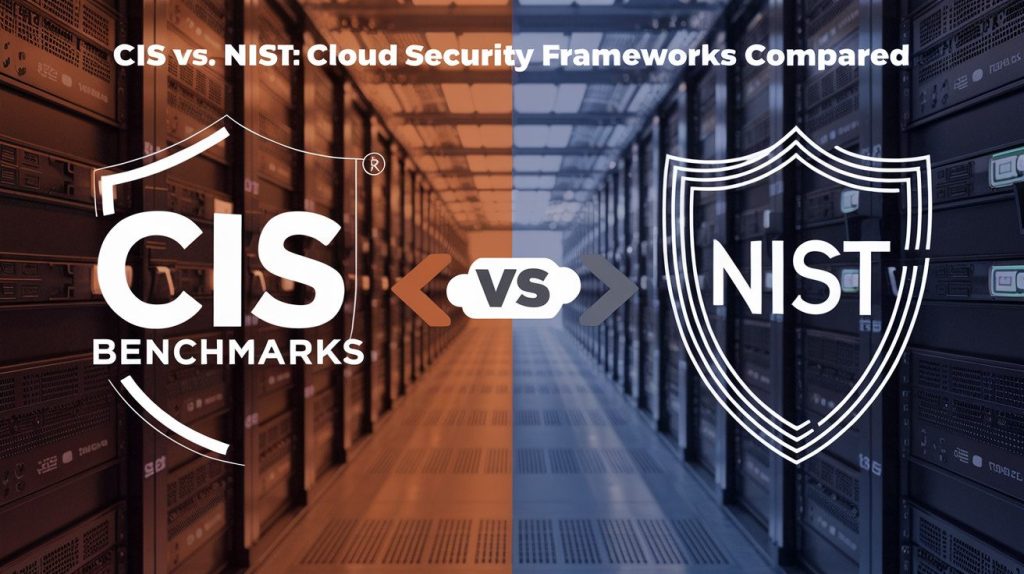
CIS Benchmarks vs. NIST: Which Should You Use for Cloud?
You stare at your screen with a slight twinge of panic. Another stakeholder just asked which security framework your cloud infrastructure follows, and you’re stuck choosing between CIS Benchmarks and NIST guidelines. Again.
Every cloud security decision feels like a high-stakes game when you’re responsible for protecting company data. The wrong choice could leave vulnerabilities wide open or create compliance nightmares.
Choosing between CIS Benchmarks and NIST for cloud security isn’t just a technical decision – it’s a strategic one that affects your entire security posture. But here’s the truth: most organizations don’t need to pick just one.
The real question isn’t which framework is better, but how to leverage the strengths of each for your specific environment.
Understanding Cloud Security Frameworks

What are CIS Benchmarks
CIS Benchmarks are your detailed roadmap for securing cloud environments. Think of them as step-by-step checklists created by security experts from around the world. When you’re setting up your AWS, Azure, or Google Cloud accounts, these benchmarks tell you exactly which security settings to enable and which configurations to avoid.
They’re incredibly specific – covering everything from password policies to network settings. You get concrete recommendations like “Ensure IAM password policy requires at least one uppercase letter” rather than vague advice.
What is the NIST Framework
The NIST Cybersecurity Framework gives you a broader, more strategic approach to security. Unlike the granular CIS Benchmarks, NIST organizes security into five core functions: Identify, Protect, Detect, Respond, and Recover.
When you adopt NIST for cloud security, you’re implementing a comprehensive risk management approach. It helps you think through your entire security program – from identifying what needs protection to planning how you’ll recover after incidents.
Core differences between the two
| CIS Benchmarks | NIST Framework |
|---|---|
| Technical, specific configurations | Strategic, organization-wide approach |
| Prescriptive checklists | Flexible, risk-based framework |
| Platform-specific guidance | Technology-agnostic principles |
| Focused on preventative controls | Covers entire security lifecycle |
| Easier to implement quickly | Requires more interpretation |
Why these frameworks matter for cloud environments
Your cloud environments face unique security challenges that on-premises systems don’t. With shared responsibility models and rapidly evolving services, you need structured approaches to stay secure.
These frameworks save you from reinventing the wheel. Instead of guessing which security controls matter most, you can follow proven practices already vetted by experts.
They also help you demonstrate compliance to auditors, customers, and stakeholders. When someone asks about your cloud security posture, you can confidently point to these industry-standard frameworks as the foundation of your approach.
CIS Benchmarks for Cloud Security
Key components and structure
When you’re exploring CIS Benchmarks for cloud security, you’re essentially getting a detailed checklist of configuration best practices. Think of them as your step-by-step guide to hardening your cloud environment. Each benchmark contains prescriptive controls organized into different levels:
- Level 1: These are your essential security configurations – must-have settings that balance security with operational needs.
- Level 2: These provide deeper security controls for environments facing higher risks.
The benchmarks break down controls into logical categories like identity management, network security, and logging configurations. Each recommendation includes the rationale, potential impact, and implementation guidance – super helpful when you’re pitching security changes to your team.
Implementation across major cloud providers
CIS Benchmarks aren’t one-size-fits-all – they’re tailored for each major cloud platform:
| Cloud Provider | Benchmark Coverage |
|---|---|
| AWS | EC2, S3, IAM, VPC, and more |
| Azure | Storage, Compute, Networking, Identity |
| Google Cloud | GKE, Compute Engine, IAM, Storage |
You’ll find detailed steps for implementing security controls specific to your cloud environment. The beauty is that these benchmarks evolve as the platforms do, so you’re not stuck with outdated guidance.
Strengths in cloud infrastructure security
The real power of CIS Benchmarks is their practicality. Unlike frameworks that speak in broad concepts, CIS gives you actionable settings you can implement today.
Their strengths include:
- Technical specificity that engineers actually appreciate
- Clear remediation steps (not just telling you what’s wrong)
- Community validation from security practitioners
- Regular updates reflecting emerging threats
- Automation-friendly format that works with your security tools
You can easily integrate CIS checks into your CI/CD pipeline, making continuous compliance a reality rather than a pipe dream.
Limitations and challenges
Despite their strengths, you might hit some roadblocks with CIS Benchmarks:
- The configuration-focused approach may miss broader governance concerns
- Implementing Level 2 controls can sometimes affect performance or functionality
- Custom cloud deployments might need adjustments to the standard recommendations
- The technical depth can be overwhelming if you’re just starting your security journey
Some organizations find the benchmarks too rigid for their specific use cases, especially when dealing with legacy applications or unique architecture patterns.
Real-world implementation examples
Many organizations use CIS Benchmarks as the foundation of their cloud security programs:
A financial services company automated CIS Benchmark scans before any infrastructure deployment, reducing their security remediation costs by 70%.
One healthcare provider mapped CIS controls to their HIPAA requirements, creating a unified compliance approach that satisfied both technical and regulatory needs.
Tech startups often start with Level 1 controls during their growth phase, then progressively implement Level 2 as their security maturity increases.
Your path might include using tools like Prisma Cloud, Aqua Security, or native cloud provider services that support CIS Benchmarks out of the box, making implementation significantly easier than manual configuration.
NIST Framework in Cloud Environments
Framework Categories and Functions
When you’re deploying the NIST Cybersecurity Framework in cloud environments, you’re working with five core functions that form its backbone: Identify, Protect, Detect, Respond, and Recover. Think of these as your cloud security roadmap.
Within each function, you’ll find categories that help you organize specific security activities:
- Identify: You’ll catalog cloud assets, business context, and risk profile
- Protect: This is where you implement access controls and data protection in your cloud
- Detect: You’ll set up monitoring to spot security events across cloud services
- Respond: You develop plans for when (not if) incidents occur in your cloud environment
- Recover: You create strategies to bounce back after security incidents
Cloud-Specific Considerations
NIST wasn’t built specifically for cloud, but you can definitely adapt it. When implementing NIST in cloud environments, you need to address:
- Shared responsibility models (what’s your job vs. your cloud provider’s)
- Multi-tenancy risks unique to cloud platforms
- Data sovereignty challenges across global cloud regions
- API security for cloud services
- Container and serverless security concerns
Flexibility and Adaptability Benefits
The beauty of NIST for cloud security? You can tailor it to your specific cloud journey. Unlike rigid standards, NIST gives you:
- Scalability across different cloud deployment models (IaaS, PaaS, SaaS)
- Adaptability to hybrid and multi-cloud environments
- Integration with your existing security programs
- Technology-neutral approach that works with any cloud provider
- Risk-based implementation that fits your unique needs
Potential Gaps in Cloud-Specific Guidance
While NIST is solid, you might hit some limitations when applying it to cloud:
- Less detailed guidance for cloud-native technologies compared to CIS
- Fewer configuration benchmarks for specific cloud services
- Limited coverage of emerging cloud technologies like serverless
- Broad guidance that sometimes requires interpretation for cloud contexts
- Need for supplementary cloud security frameworks to fill specific gaps
Comparative Analysis: CIS vs. NIST
Technical depth and specificity
When comparing cloud security frameworks, technical depth matters. CIS Benchmarks give you exact, actionable settings – like “set password length to 14 characters” or “enable logging on S3 buckets.” They’re practically plug-and-play for cloud environments with specific configurations for AWS, Azure, GCP, and other platforms.
NIST, on the other hand, takes a broader approach. Instead of saying “do X specific thing,” NIST frameworks outline general security principles and leave implementation details to you. This flexibility is both a blessing and curse – you get adaptability but fewer direct instructions.
Ease of implementation and maintenance
CIS wins the quick-start race. Their benchmarks are step-by-step instructions that security teams can immediately implement. Many cloud providers even offer CIS-hardened images that come pre-configured to match the benchmarks.
NIST requires more translation work. You’ll spend time interpreting how abstract controls apply to your cloud environments. But this investment pays off in the long run – NIST’s framework adapts more smoothly as technologies evolve, potentially requiring fewer major overhauls to your security program.
Compliance alignment with industry regulations
Both frameworks help with compliance, but in different ways:
| Regulation | CIS Alignment | NIST Alignment |
|---|---|---|
| HIPAA | Good | Excellent |
| PCI DSS | Excellent | Good |
| GDPR | Good | Good |
| CMMC | Good | Excellent |
Making the Right Choice for Your Organization
Assessing your cloud security objectives
Got a minute to think about what you really need from your cloud security? This is your first step in deciding between CIS Benchmarks and NIST. Ask yourself:
- Are you mainly focused on technical configurations for your cloud services?
- Do you need a comprehensive framework that addresses your entire security program?
- What are your compliance requirements? Some industries require specific frameworks.
Your objectives might be tactical (like hardening cloud configurations) or strategic (building an enterprise-wide security program). CIS Benchmarks excel at the tactical level with specific cloud configuration guidance, while NIST gives you that big-picture view with flexibility for implementation.
Evaluating your security maturity level
Where are you on your security journey? Be honest with yourself here.
If you’re just starting out, CIS Benchmarks offer clear, actionable steps that give you quick wins. Their Level 1 profiles are perfect if you’re building up your cloud security from scratch.
For organizations with more sophisticated security programs, NIST’s risk-based approach probably aligns better with how you already think about security.
Maturity Level | Better Framework Choice
---------------|------------------------
Beginning      | CIS Benchmarks (Level 1)
Intermediate   | CIS Benchmarks (Level 2)
Advanced       | NIST or Hybrid Approach
Considering hybrid framework approaches
Who says you need to pick just one? Many organizations get the best results by combining frameworks.
You might use CIS Benchmarks for your cloud configuration baselines while leveraging NIST CSF for your overall security strategy. This hybrid approach gives you both the technical specificity and the comprehensive coverage you need.
For example, use CIS to secure your AWS environment while applying NIST’s risk management principles to prioritize your security investments.
Key decision factors for different organization sizes
Your organization’s size plays a huge role in which framework works best:
Small businesses: You probably have limited resources, so CIS Benchmarks provide concrete guidance without overwhelming your team. Start with Level 1 controls to address the most critical risks.
Mid-sized organizations: You might benefit from a hybrid approach, using CIS for technical implementations while gradually adopting NIST principles as you scale.
Enterprises: Your complex environments typically require NIST’s flexibility and comprehensive approach, though you’ll still find value in CIS Benchmarks for specific technical implementations.
Choosing the right security framework for your cloud environment is critical to your organization’s security posture.
Both CIS Benchmarks and the NIST Framework offer robust approaches, with CIS providing detailed technical configurations and NIST offering a comprehensive risk management perspective. Your decision should be guided by your organization’s specific needs, technical resources, compliance requirements, and security maturity level.
Remember that these frameworks aren’t mutually exclusive; many organizations implement both to maximize security benefits.
CIS Benchmarks can deliver immediate security improvements through specific configurations, while NIST provides the strategic framework to build your overall security program.
Ultimately, the best approach is to evaluate your unique cloud environment and security objectives, then adopt the framework, or combination of frameworks, that best helps you achieve your security goals.
I’ve built a platform that shows you how you can build the right hands-on cybersecurity skills to help businesses achieve their cloud security goals while you’re also building the career you love for a better, higher-paying reward. Check it out here and start working on projects that get you hired.
The Author