The 5 Must-Have Automated Security Checks for Any Cloud
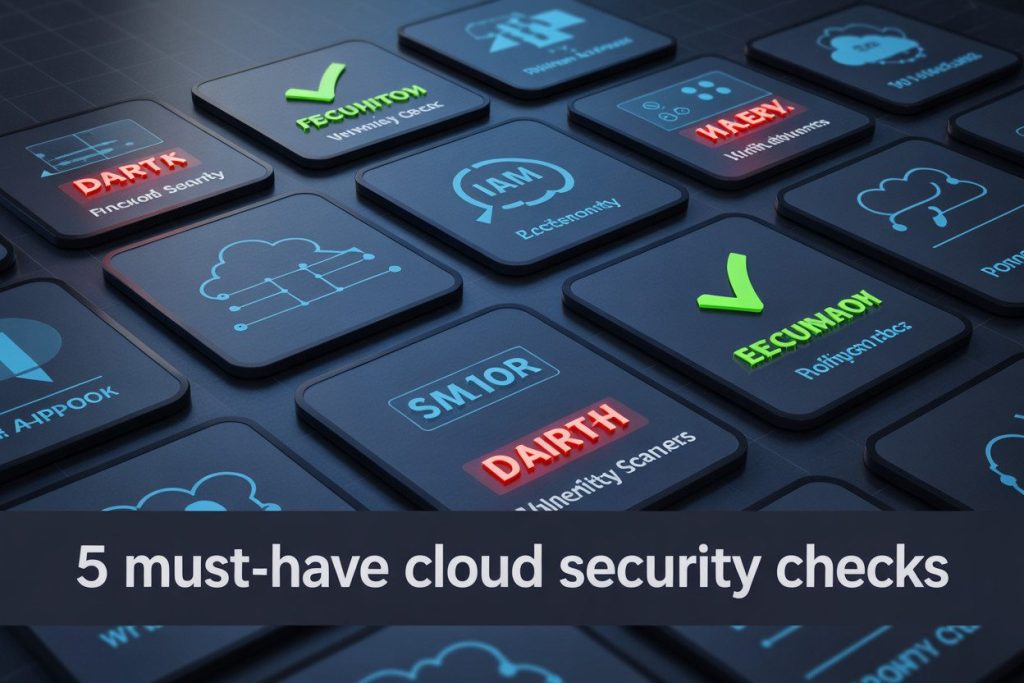
The 5 Must-Have Automated Security Checks for Any Cloud
Cloud security teams and DevOps professionals need reliable, consistent ways to protect their cloud environments.
Implementing automated security checks saves time and reduces human error in your cloud infrastructure.
In this guide, we’ll cover essential automated checks, including IAM verification to control who accesses your systems and vulnerability scanning to identify weaknesses before attackers do.
We’ll also look at how automated network security monitoring and data encryption verification create multiple layers of protection for your cloud resources.
Understanding Cloud Security Automation Fundamentals
Why automated security is critical in cloud environments
The cloud changed everything about how you run your business, including your security risks. When your assets live in the cloud, traditional security approaches simply don’t cut it anymore.
Manual security processes that worked in on-premise environments become painfully inadequate when dealing with the dynamic nature of cloud resources.
Think about it: your cloud infrastructure can scale up or down in minutes. New services get deployed daily. Configuration changes happen constantly. How can any security team keep up without automation?
You’re fighting an uphill battle if you’re still relying on manual security checks. While your team is manually reviewing logs or configurations, attackers are using automated tools to find vulnerabilities. It’s like bringing a knife to a gunfight.
The rising costs of security breaches in cloud systems
The numbers will make you sweat. The average cost of a data breach hit $4.35 million in 2022. And cloud-based breaches? They typically cost even more.
When your cloud environment gets compromised, you’re not just looking at direct financial losses. You’re facing:
| Breach Consequence | Potential Cost |
|---|---|
| Regulatory fines | Up to 4% of global revenue (GDPR) |
| Customer compensation | $100-$400 per compromised record |
| Brand damage | 20-60% customer churn rates |
| Operational downtime | $5,600 per minute (average) |
How automation reduces human error and improves response time
You’re only human, and humans make mistakes. A single misconfiguration in your cloud environment can expose sensitive data to the world. Security automation catches these errors before they become problems.
With automated security, you’re not waiting for the quarterly audit to discover issues. Your systems continuously monitor for problems and alert you immediately. Better yet, many issues get fixed automatically without any human intervention.
Response time makes all the difference in security. When a breach happens, minutes matter. Automated systems can detect and respond to threats in seconds, while manual processes might take hours or days. That’s the difference between a minor incident and a major disaster for your business.
Identity and Access Management (IAM) Verification
A. Detecting over-privileged accounts automatically
You’ve probably seen it before – an employee gets assigned permissions they don’t need “just in case,” and suddenly your cloud environment is full of security risks. Over-privileged accounts are ticking time bombs.
Automated tools can scan your entire cloud environment daily, flagging accounts with unused permissions or excessive rights. Most cloud providers offer native tools for this: AWS has IAM Access Analyzer, Azure has Privileged Identity Management, and GCP has Policy Analyzer.
Set up these automated checks to run weekly and send you a prioritized list of the riskiest accounts. You’ll cut your attack surface dramatically without spending hours manually reviewing permissions.
B. Monitoring for unusual access patterns
Normal user behavior creates patterns. When those patterns break, something’s up.
Automated monitoring tools spot the weird stuff right away – like when your finance director suddenly accesses development databases at 3 AM from an IP address in a country they’ve never logged in from before.
Cloud SIEM solutions integrate with your IAM systems to establish baselines for each user and role. They’ll flag anomalies like:
- Access attempts outside normal working hours
- Multiple failed login attempts
- Access from unusual locations
- Sudden privilege escalation
C. Enforcing the principle of least privilege through automation
Manually managing least privilege is practically impossible in complex cloud environments. That’s where automation saves you.
Dynamic access controls can temporarily elevate permissions only when needed, then automatically remove them when the task is complete.
Just-in-time access provisioning means your developers get database admin rights for the maintenance window, then lose them when it closes.
Role mining tools analyze actual usage patterns and suggest permission reductions that won’t impact productivity. They’ll identify which S3 buckets a role actually needs to access, rather than giving blanket permissions.
D. Streamlining multi-factor authentication compliance
Tracking MFA compliance across hundreds of accounts is a nightmare without automation.
Set up automated systems to enforce MFA on all privileged accounts and critical systems. These tools can continuously verify MFA status, automatically remediate non-compliant accounts, and generate compliance reports for auditors.
Smart MFA systems can even adjust authentication requirements based on risk signals – requiring additional verification when access requests look suspicious, but streamlining access when risk is low.
Vulnerability and Patch Management Automation
Continuous scanning for known vulnerabilities
Staying ahead of vulnerabilities in your cloud environment isn’t optional anymore. When you’re running workloads in the cloud, new threats emerge daily. Setting up automated continuous scanning tools gives you a 24/7 security guard that never sleeps or takes coffee breaks.
Tools like AWS Inspector, Azure Security Center, or GCP Security Command Center automatically scan your cloud resources and alert you when vulnerabilities are detected. You’ll want to configure these scans to run at least daily, if not more frequently.
Automated patch deployment and verification
Nothing kills productivity faster than manually patching hundreds of systems. Automation transforms this headache into a smooth, reliable process.
You can use tools like AWS Systems Manager, Azure Update Management, or Chef Automate to schedule patches during maintenance windows.
The real power comes when you set up verification checks that confirm each patch was successfully applied. This way, you’re not just hoping those critical security fixes took hold—you know they did.
Container image security validation
Your containers are only as secure as the images they’re built from. Automated validation before deployment catches issues before they become problems.
By implementing tools like Clair, Trivy, or Docker Security Scanning in your workflow, you’ll automatically detect vulnerabilities in container images. Configure these tools to fail builds when critical vulnerabilities are found—this prevents insecure containers from ever reaching production.
Compliance reporting for regulatory requirements
Compliance audits can be panic-inducing without proper automation. When you implement automated compliance reporting, you transform audit time from crisis mode to confidence mode.
Set up your cloud security posture management tools to generate weekly or monthly compliance reports against frameworks like HIPAA, PCI-DSS, SOC 2, or GDPR. These automated reports provide documentation that auditors love and give you a continuous view of your compliance status.
Integration with CI/CD pipelines
Security checks that slow down deployment aren’t going to win friends with your dev team. But when you integrate security scanning directly into your CI/CD pipelines, you get security without the speed penalty.
Add vulnerability scanning steps to your Jenkins, GitHub Actions, or GitLab CI workflows. Your developers will get immediate feedback on security issues right in their pull requests. This shifts security left in your development lifecycle and prevents vulnerable code from moving forward.
Network Security Configuration Monitoring
Firewall Rule Validation and Redundancy Detection
You’ve probably been there – trying to manage countless firewall rules that accumulate over time. Cloud environments make this even messier. Automated firewall rule validation isn’t just nice to have; it’s essential.
Set up automated scans to identify:
- Conflicting rules that cancel each other out
- Redundant rules that slow down traffic processing
- Overly permissive rules creating security gaps
- Outdated rules for decommissioned services
Think about it: every unnecessary rule increases your attack surface. When you automatically detect and clean up these issues, you’re not just improving security; you’re boosting performance too.
Network Segmentation Verification
Your network segmentation strategy is only as good as your ability to verify it stays intact. As your cloud environment grows, it’s painfully easy for segmentation to break down.
Automate checks to confirm:
- Production environments remain isolated from development
- Customer data stays properly segregated
- High-value assets have appropriate perimeter controls
- Cross-environment traffic follows approved patterns
Without regular automated verification, you might discover segmentation failures only after a breach has occurred. By then, it’s way too late.
Exposed Service and Port Scanning
Cloud environments change constantly. New services get deployed, configurations drift, and suddenly you’ve got exposed ports you never intended.
Run automated scans to detect:
- Unexpected public-facing services
- Open management ports (SSH, RDP, admin interfaces)
- Recently exposed endpoints from configuration changes
- Non-standard services running on standard ports
Remember that attackers continuously scan your perimeter. If you’re not scanning yourself first, you’re giving them the advantage. Automated scanning puts you back in control of your network edge.
Data Protection and Encryption Verification
A. Automated detection of unencrypted data at rest
When your sensitive data sits unencrypted in cloud storage, you’re basically leaving your digital front door wide open. Automated tools can continuously scan your cloud environment to flag unprotected data across S3 buckets, databases, and storage volumes.
Set up automated scans to run daily and alert you when they find:
- Unencrypted database instances
- Storage buckets missing encryption settings
- Clear-text credentials or PII
- File shares with sensitive content lacking encryption
Don’t wait for a breach to discover these gaps. Most major cloud providers offer native tools that integrate with your existing security workflow to catch these issues before attackers do.
B. Encryption key rotation monitoring
Your encryption is only as strong as your key management. Think of encryption keys like your house keys – you wouldn’t keep the same one for decades, especially if multiple people have had access to it.
Automated key rotation ensures you’re regularly changing these critical security elements. Your monitoring should track:
- Keys approaching rotation deadlines
- Failed rotation attempts
- Orphaned or unused keys
- Access patterns suggesting compromise
The best automation doesn’t just alert you to problems – it handles the rotation process on schedule without disrupting operations.
C. Data loss prevention through automated controls
You can’t manually track every piece of data flowing through your cloud environment. Automated DLP controls act like intelligent guardians that:
- Identify sensitive data patterns in transit and at rest
- Block unauthorized sharing of protected information
- Prevent accidental exposure through misconfigurations
- Create audit trails of access and movement
Configure these systems to understand your specific data types and compliance requirements. Cloud-native DLP tools can integrate with your workflows to provide protection without slowing down legitimate business processes.
D. Backup verification and recovery testing
Regular backups mean nothing if they don’t work when you need them. Automated verification systems do more than just check if backups exist – they validate their integrity and usability.
Your automated testing should:
- Restore random samples to verify data integrity
- Measure recovery time against your objectives
- Simulate different failure scenarios
- Verify application consistency post-restoration
Don’t discover backup failures during an actual disaster. Schedule these tests to run automatically after each backup cycle and deliver reports showing exactly what would happen in a real recovery situation.
Securing your cloud infrastructure is no longer optional in today’s threat landscape. By implementing these five essential automated security checks- IAM verification, vulnerability management, network security monitoring, data protection verification, and encryption validation- organizations can significantly reduce their risk exposure while maintaining operational efficiency.
These automated safeguards create a foundation for proactive security that scales with your cloud environment.
Cloud security is an ongoing journey, not a destination. Start by implementing these five critical checks, then continuously refine and expand your automated security framework as your cloud footprint evolves.
Your security posture is only as strong as its most consistent components, and automation ensures these vital checks occur reliably and comprehensively across your entire cloud ecosystem.
And I’ve also built a platform that shows you how to build the right hands-on cybersecurity skills to help businesses achieve their cloud security goals while you build the career you love for a better, higher-paying reward. Check it out here and start working on projects that will help you get hired.
The Author